

This post has already been read 1 times!

What if some of the habits holding you back professionally have less to do with your abilities and more to do with the emotional patterns you have learned to repeat?
We all experience difficult emotions. Disappointment, frustration, self-doubt, resentment and fear are part of being human.
Yet, have you ever noticed how certain situations seem to trigger the same reactions in you, even when you know that reacting differently might produce a better outcome? Or you realize the exact trigger when analyzing the situation and how you were unable to respond instead of react.
Perhaps you become defensive when someone questions your work. Maybe you withdraw when your contributions go unnoticed. Or perhaps you find yourself procrastinating on opportunities that could take your career to the next level.
These responses may seem like isolated incidents. But sometimes they are manifestations of deeper emotional and behavioural patterns that have developed over time.
These patterns can influence much more than your mood. They can affect your energy, confidence, relationships, decision-making and the way others experience your leadership.
The good news is that once you become aware of these patterns, you can begin making different choices.
Let’s explore three important connections that can help you understand yourself better and develop a more intentional approach to personal and professional growth.
How negative emotional patterns become habits
Have you ever found yourself reacting to a situation in a way that you later regretted?
Perhaps you responded sharply to a colleague, avoided a difficult conversation or allowed a minor setback to affect your confidence for the rest of the day.
When these reactions become repetitive, they can develop into habitual ways of thinking and behaving.
Consider what happens when you repeatedly approach challenging situations with frustration or self-doubt.
You experience a negative emotion. That emotion influences your thoughts, which in turn influence your actions. The resulting experience may reinforce your original beliefs, making it increasingly likely that you will respond in the same way next time.
Over time, this becomes a self-reinforcing cycle.
For example:
- You feel overlooked when your contributions aren’t acknowledged.
- You begin questioning your professional worth.
- You stop volunteering for visible assignments.
- You receive fewer opportunities to demonstrate your capabilities.
- This reinforces your belief that you aren’t being recognized.
The problem is no longer just the original experience. It is the pattern that has developed around it.
This is particularly important in leadership.
A capable professional may have all the technical knowledge and experience required for a leadership position but struggle to demonstrate confidence, composure or influence because certain emotional triggers repeatedly affect her behaviour.
Breaking the emotional patterns cycle begins with awareness
Start by noticing situations in which you repeatedly experience the same emotions or behave in predictable ways.
Ask yourself:
- What situations tend to trigger this reaction?
- What am I telling myself when this happens?
- How do I usually respond?
- Is my response helping me achieve the outcome I want?
Once you recognize the pattern, you can experiment with a different response.
Instead of immediately becoming defensive, pause and consider the feedback. Instead of withdrawing when you feel overlooked, communicate your contributions more confidently. Don’t avoid a difficult conversation, but prepare for it and approach it constructively.
The objective isn’t to suppress your emotions or force yourself to remain positive all the time.
It is to develop enough self-awareness to choose your response rather than automatically repeating an old behaviour.
The connection between emotions and energy
Your emotional state doesn’t just influence how you feel. It can also influence how much energy you have available for the activities that matter.
Think about the difference between starting your day feeling enthusiastic about an interesting project and beginning it feeling overwhelmed by a problem that has been occupying your thoughts.
The same person, with the same capabilities, can experience very different levels of motivation and engagement depending on their emotional state.
This happens because emotions influence the body’s arousal, attention and motivation systems.
When something feels interesting or meaningful, you are more likely to become engaged and motivated. Your attention sharpens, and you may find it easier to concentrate on the task.
On the other hand, prolonged stress, worry and emotional frustration can consume considerable mental energy.
You might find yourself:
- Replaying difficult conversations in your head.
- Worrying about how colleagues perceive you.
- Struggling to concentrate on important assignments.
- Procrastinating because a task feels overwhelming.
- Feeling mentally exhausted even when you haven’t accomplished much.
Boredom and a lack of meaningful engagement can also affect motivation.
This is why changing your approach to a task, taking a short break, moving your body or introducing something stimulating into your environment can sometimes make a noticeable difference.
Positive experiences matter too.
Meaningful conversations, supportive relationships, laughter and activities you enjoy can help restore your sense of connection and engagement.
However, there is an important distinction here.
You don’t have to feel happy or energetic every moment of the day to be productive or effective.
Leadership requires the ability to recognize your emotional state and respond appropriately, even when circumstances are difficult.
For example, when you are frustrated with a team member, you may need to pause before responding. When you feel overwhelmed, you may need to prioritize rather than attempt to do everything simultaneously.
Managing your emotional energy is therefore an important part of managing yourself.
The more aware you become of what drains or restores your energy, the better equipped you are to make intentional decisions about how you spend it.
How your environment shapes your self-image
Your environment plays a significant role in shaping the way you think, feel and behave.
This includes your physical surroundings, the people you interact with, the information you consume and the expectations you place on yourself.
Imagine working in an environment where your contributions are regularly dismissed, mistakes are treated harshly and colleagues rarely acknowledge one another’s achievements.
Even a confident professional may eventually begin questioning her abilities in such circumstances.
Now imagine working in an environment where people exchange constructive feedback, recognize good work and encourage professional development.
The difference can be significant.
While you cannot always control your surroundings, you can take deliberate steps to create an environment that supports a healthier self-image and more constructive behaviour.
Here are four places to start.
1. Create space for reflection
Meditation, journaling and quiet reflection can help you become more aware of your thoughts and emotional responses.
Even a few minutes of reflection each day can help you recognize recurring concerns, question unhelpful assumptions and reconnect with what matters to you.
For professionals in leadership positions, this creates an opportunity to step away from the constant demands of decision-making and consider how they are showing up.
2. Become intentional about the people around you
The people you spend time with can influence your attitudes, confidence and outlook.
If you are constantly exposed to criticism, pessimism or unhealthy competition, it can become harder to maintain perspective.
Where possible, minimize unnecessary exposure to consistently negative interactions.
At the same time, build relationships with people who encourage growth, offer constructive feedback and celebrate your progress.
This doesn’t mean surrounding yourself with people who always agree with you. Genuine support sometimes means having someone challenge your assumptions and help you see another perspective.
3. Examine the pressures you carry
Financial uncertainty, unresolved responsibilities and competing personal commitments can contribute to stress.
Taking practical steps to address these pressures can create greater mental space for professional and personal growth.
This might mean reviewing your finances, establishing clearer boundaries, organizing your priorities or seeking help where necessary.
You don’t have to resolve everything immediately. Sometimes, taking one manageable step is enough to restore a sense of direction.
4. Challenge the image you have created of yourself
Perhaps the most important environment to examine is your internal one.
What do you believe about yourself?
Do you see yourself as someone capable of taking on greater responsibility? Or do you continually question whether you are ready?
Do you believe your voice deserves to be heard? Or do you hesitate to express your views because you fear being judged?
Recognizing these beliefs gives you an opportunity to decide whether they still serve you.
You don’t need to become someone else to grow. You need to understand which parts of your existing self-image support your aspirations and which ones may be limiting them.
Bringing it all together: From Emotional Awareness to Intentional Leadership
There is a common thread running through all three areas.
Your emotional habits influence your behaviour and your emotional state affects your energy and motivation. Your environment reinforces certain beliefs and patterns.
Together, these factors influence how you approach challenges, interact with people and respond to opportunities.
This is particularly relevant when you are moving towards greater leadership responsibility.
Executive presence isn’t simply about speaking confidently, dressing professionally or knowing how to conduct yourself in a boardroom.
It also involves understanding the internal emotional patterns that influence how you communicate, make decisions and respond under pressure.
For instance, do you:
- Become defensive when your authority is challenged?
- Hesitate to express an unpopular opinion?
- Find it difficult to acknowledge your own achievements?
- Allow the fear of making mistakes to influence your decisions?
- Respond to pressure with composure or become reactive?
These questions aren’t intended to make you judge yourself.
They are invitations to develop greater self-awareness.
This is where shadow work can become a valuable part of leadership development.
Shadow work, in this context, is about exploring the aspects of yourself that you may not always recognize or acknowledge, including recurring emotional responses, hidden assumptions and behavioural patterns.
It isn’t about labeling yourself negatively or dwelling on past experiences.
It is about understanding what influences your behaviour so that you can make more conscious choices.
The objective is not perfection. It is greater awareness, flexibility and intentional action.
Final Thoughts: Your growth begins with self-awareness about your emotional patterns
Let’s be honest. You may not be able to control every situation you encounter at work or in your personal life.
You cannot always determine how others behave, whether your contributions receive recognition or when unexpected challenges arise.
But you can develop a better understanding of how you respond to these experiences.
You can recognize recurring emotional patterns, become more intentional about your environment and challenge beliefs that no longer support your aspirations.
Most importantly, you can learn to respond differently.
Every time you pause before reacting, question an unhelpful assumption or choose a more constructive course of action, you create an opportunity to move beyond an old pattern.
And that is an important part of becoming the leader you aspire to be.
Your leadership journey begins with understanding the person behind the professional and their underlying emotional patterns.
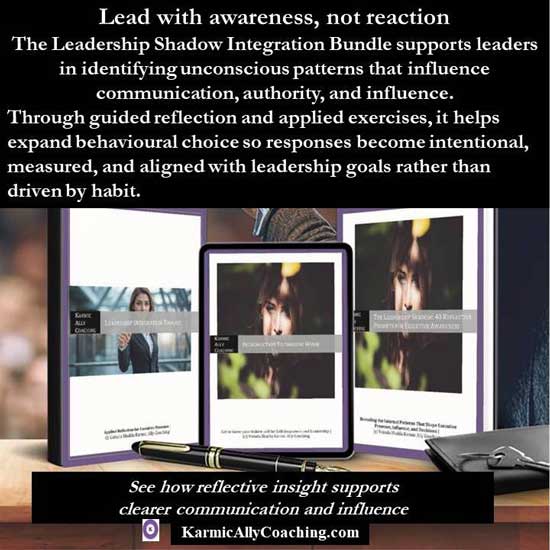
Explore The Leadership Shadow Integration Bundle
Understanding your leadership shadow is an opportunity to discover the internal emotional patterns that influence your executive presence, communication and decisions.
The Leadership Shadow Integration Bundle brings together three resources to help you move from awareness to reflection and practical application.
- Introduction to Shadow Work
- 40 Reflective Prompts for Executive Awareness
- Leadership Integration Toolkit
Build greater self-awareness, emotional regulation and intentional leadership.
Explore this self-paced bundle. Begin your leadership integration journey with the Leadership Shadow Integration Bundle.

 Vatsala is a dynamic professional with a human touch. She was instrumental in assisting me through a challenging phase a year ago and I still put to use the techniques she generously shared for ensuring personal well-being in the humdrum of life. I wish her the best.
 Posts
 I adhere to the Certified Coaches Alliance Code of Ethics and Standards. A copy is available on request.

 Let's Talk through the Connect Form: