

This post has already been read 14 times!

Your thoughts really are a reflection of your career and life because what we believe and think influences our experiences.
That doesn’t mean that positive thinking magically makes everything work out.
Life will still throw unexpected situations, disappointments and circumstances at us that are outside our sphere of control.
But our thoughts influence what we do next and that is where self-leadership comes in.
Self-leadership is not about pretending everything is wonderful.
It is about becoming aware of your thoughts, questioning the stories you tell yourself, and choosing how you respond rather than automatically reacting.
I was reminded of this recently by something as mundane as my Voter ID.
Apparently, according to the electoral roll, I didn’t exist.
If you are an Indian citizen, consider yourself fortunate if the current SIR (Special Intensive Revision) process has resulted in your details being correctly mapped. It means you are on the electoral roll.
In the housing society where I live, almost every second person has received a notice because of mapping issues relating to the previous revision in 2003.
The Common Room that Saturday was a sea of people waiting to speak to the Booth Level Officer. Everyone needed to work out how to fill in the details required in the notice.
I was there too but for a completely different reason.
Back in 2003, I wasn’t living in India. When I subsequently returned, the previous Booth Level Officer had to get my name added to the electoral list.
She did that successfully. At least that was what I thought.
The spelling of my name was correct in Hindi, but the English spelling did not match my Aadhaar (Government identity document) details.
So I filed the required form to have my name corrected and somehow, in the process of correcting my name, my Voter ID disappeared altogether.
According to the Election Commission’s website, apparently, I don’t exist.
You can imagine the irony.
So there I was in the Common Room, waiting to ask the new Booth Level Officer what I was supposed to do.
Unfortunately, she didn’t have an answer.
I joked with some of the other residents that they were lucky. At least they had received notices. I didn’t even exist!
It would have been very easy to get caught up in the frustration.
The thoughts that could have hijacked my mind
How could this happen?
Why did nobody inform me?
What am I supposed to do now?
Why does correcting one thing result in another thing being removed?
And yes, I was frustrated.
But there was something else I needed to do that afternoon.
I had to take Coco to the vet for a follow-up visit for her conjunctivitis. We’d had a scare about glaucoma in November 2024, so both the vet and I wanted to make sure that everything was okay.
So I left the Common Room, took Coco to the clinic before it closed, and dealt with the Voter ID issue later by putting in a complaint about the unexplained removal.
Now I wait for a response.
What do our thoughts have to do with self-leadership?
If you really want to know – quite a lot, actually.
Self-leadership doesn’t mean that you never get annoyed.
It doesn’t mean you put on a smile and tell yourself that everything happens for a reason.
And it certainly doesn’t mean ignoring problems.
What it does mean is recognizing what is within your sphere of control and deciding where to put your energy.
In my case, I couldn’t immediately fix what had happened to my Voter ID.
I couldn’t make the Booth Level Officer magically know the answer.
I couldn’t change the fact that the system had created a problem.
What I could decide was what deserved my attention that afternoon.
Coco did.
Once that immediate priority was taken care of, I could take the next practical step.
That, to me, is a much more useful definition of positive thinking.
Your thoughts become your filters
We all develop habitual ways of interpreting what happens to us.
One person encounters a problem and immediately thinks:
“Of course this would happen to me.”
Another thinks:
“Okay. This is inconvenient. What can I do about it?”
The circumstance may be identical.
The internal experience, and often the resulting action, can be very different.
When we habitually look for reasons why something won’t work, we become very good at finding them.
Every suggestion becomes a problem.
Every opportunity comes with a reason it won’t work.
Each setback becomes evidence that life is against us.
Eventually, this way of thinking can become so habitual that we stop noticing it.
We simply call it reality.
But sometimes what we call reality is actually a combination of circumstances and the interpretation we have placed on those circumstances.
And this is where things become particularly interesting.
Some of the thoughts influencing our choices aren’t simply passing thoughts.
They can be rooted in limiting beliefs. The deeply held assumptions about ourselves, other people or what is possible for us.
A professional woman might think:
“I’m not ready for that role.”
“I’m not naturally good at speaking up.”
“Other people are more qualified than I am.”
“I don’t want to appear pushy.”
“If I make a mistake, people will realize I don’t belong here.”
These thoughts can feel like facts.
But a thought can feel true without necessarily being true.
When a belief remains unquestioned for long enough, it can quietly influence the opportunities we pursue, the risks we take and the boundaries we set.
Even the level of success we allow ourselves to imagine.
(Tip: Try muscle testing to check your limiting beliefs)
Positive thinking isn’t about having all the answers
There is another misconception about positive thinking that I think is worth challenging.
Being positive doesn’t mean believing that every idea will work.
It doesn’t mean being optimistic about everything.
And it certainly doesn’t mean ignoring evidence.
A self-led person can say:
“This isn’t working.”
“I don’t know the answer.”
“I need more information.”
“I made a mistake.”
“This situation is frustrating.”
Those aren’t negative thoughts but observations.
The difference lies in what happens next.
Do you become trapped in the thought? Or do you use it as information and decide what to do next?
That is where self-awareness becomes self-leadership.
Your mental habits influence your future
When you repeatedly tell yourself that you are not capable, you will probably approach opportunities differently from someone who believes they can learn.
If you assume that people are judging you, you may hold yourself back from speaking up.
If you believe that every setback proves you are failing, you may give up before you’ve explored other options.
And if you have developed a belief that you need to be completely ready before you step forward, you may keep waiting for confidence instead of allowing confidence to develop through action.
These patterns can have real consequences not only in life situations, but also in our careers.
They can influence whether we apply for the role.
Whether we ask for the promotion, speak up in meetings, and negotiate when it matters.
Whether we make ourselves visible and whether we believe we belong in the room.
But if you learn to pause and question those thoughts, you create space for another response.
Not necessarily a positive response, but a more useful response.
That distinction matters.
Sometimes the most empowering thought isn’t:
“Everything will be fine.”
It is:
“I don’t know how this will turn out, but I can decide what I do next.”
That is self-leadership.
From awareness to changing the pattern
Becoming aware of your thoughts is an important first step.
But awareness doesn’t always mean the pattern changes immediately.
You recognize that you have a tendency to second-guess yourself and still find yourself doing it.
You can know that you have a fear of failure and still hesitate when an important opportunity appears.
It includes intellectually understanding that a belief is limiting and still feel its influence.
That is because changing deeply ingrained thought patterns requires more than simply telling yourself to think differently.
It requires becoming curious about the belief behind the thought.
Where did it come from?
What evidence supports it?
What evidence challenges it?
How has it influenced your behavior?
And, perhaps most importantly:
What would you do differently if you no longer allowed that belief to make your decisions for you?
This is the deeper work behind mind mastery.
It isn’t about forcing yourself to think positively.
It is about becoming more conscious of the mental patterns that shape your choices and learning to develop patterns that support the person and professional you are becoming.
Negative thoughts can become a habit but so can awareness
We are surrounded by reasons to become negative.
News stories, social media, workplace frustrations, difficult relationships and even well-meaning people can reinforce the habit of looking for what is wrong.
And sometimes we do it ourselves.
We rehearse the same complaints and replay conversations, anticipate problems before they happen and collect evidence for our existing beliefs.
The good news is that habits can change.
The first step isn’t to force yourself to become relentlessly positive.
It is to notice your thinking.
Ask yourself:
- What am I telling myself about this situation?
- Is this a fact or my interpretation?
- What belief might be sitting underneath this thought?
- What part of this situation is within my control?
- What is the next useful action I can take?
- Am I spending energy solving the problem or simply rehearsing it?
These questions shift you from reacting to leading.
And that is the essence of self-leadership.
Want to work more deeply on your thinking?
If you recognize that some of your habitual thoughts may be influencing your confidence, decisions or career possibilities, you may benefit from going deeper than simply trying to “think positive.”
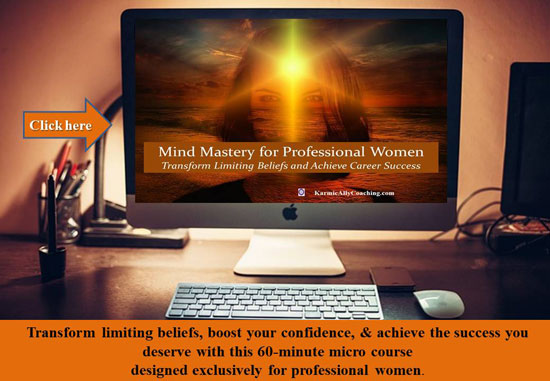
Mind Mastery for Professional Women is designed to help you identify and challenge limiting beliefs, transform unhelpful thought patterns and develop a mindset that supports greater confidence and career success.
It isn’t about convincing yourself that everything will work out.
It is about understanding the mental patterns that may be holding you back and learning to respond to them differently.
Sometimes the biggest career obstacle isn’t a lack of ability.
It is the story we have unconsciously learned to tell ourselves about what we are capable of.
Explore Mind Mastery for Professional Women →
You cannot always choose what happens to you.
But you can become much more intentional about what happens inside you and after you.
Your thoughts may not control your entire life.
But the thoughts you repeatedly entertain can influence the choices you make, the actions you take, the people you surround yourself with and the possibilities you are willing to consider.
So perhaps the question isn’t:
“Am I a positive or negative thinker?”
A better question is:
“Are my thoughts helping me lead myself well?”
Your circumstances may shape your day, but the way you think about those circumstances can shape what you do with your life.

 Posts
Posts
 I adhere to the Certified Coaches Alliance Code of Ethics and Standards. A copy is available on request.
 Let's Talk through the Connect Form: