

This post has already been read 128 times!

Is your leadership identity visible to the decisionmakers? After coaching ambitious women professionals for years, I’ve noticed that many career setbacks aren’t caused by a lack of competence.
They’re caused by breaking a few unspoken laws of leadership that nobody teaches us.
This is how it plays out.
You work hard, deliver results and solve problems.
Your team experiences psychological safety in the workplace and you are seen as a supportive manager.
Yet somehow, less capable colleagues seem to get noticed, trusted with bigger opportunities, and promoted ahead of you.
If this sounds familiar, the issue may not be your skills, experience, or work ethic.
It may be your leadership identity.
In this post, we’ll explore five leadership identity truths that can quietly shape the trajectory of your career.
You’ll also be prompted to ask yourself questions about the truth and how it may relate to you.
1. Competence doesn’t create Leadership Identity
In the early stages of our career, many women believe that their hard work will speak for them, and their efforts will be recognized.
Demonstrating competency is important because that is the skill that gets you hired and helps you perform.
It also helps you to earn the trust of your supervisor and fellow team members.
You may get promoted to a team leader or manager position, but when it comes to leadership roles at a higher level, the rules of the game change.
Leadership roles are rarely awarded based solely on what you’ve already accomplished.
Senior leaders are evaluating something different:
Can they see you operating successfully at the next level?
The challenge I’ve observed is that many women become known as the reliable expert, the dependable problem-solver, or the person who always gets things done.
While those qualities are valuable, they don’t automatically position you as a strategic leader.
The uncomfortable truth is that you can become indispensable in your current role and invisible for the next one.
Ask Yourself:
How much time do you spend demonstrating leadership capacity versus proving competence?
2. People believe the Leadership Story you tell about yourself
With every meeting, every conversation and every opportunity you either claim or decline, you’re constantly shaping your professional reputation.
In my short audio blog, The Truth about Good Performances not resulting in Promotions, I shared 5 subtle ways self-sabotage often shows up for high-performing women professionals.
Many women unknowingly do self-sabotage when they communicate a leadership story that sounds like:
- I’m here to help
- I don’t want to take credit
- I don’t want to appear arrogant
- I’m not quite ready yet
To be a leader who advances, you need to communicate a very different story:
- I solve important problems
- I influence outcomes
- I create value
- I lead change
The story people hear repeatedly becomes the story they believe.
Eventually, it becomes the story they tell about you when you’re not in the room.
Ask Yourself:
What leadership story are your actions telling?
3. Visibility is not Self-Promotion
This is a big mind-set shift women leaders need to make.
As I mentioned earlier, relying on your competency to demonstrate leadership identity doesn’t work.
I once coached a high-achieving professional who consistently exceeded expectations. She had been told a promotion would be hers if she delivered on ambitious goals.
She did.
In fact, she exceeded them.
Yet, the promotion went to someone else. It wasn’t because he was more capable but because he was more visible.
Here’s what many women professionals get wrong:
They think visibility means bragging.
They worry that talking about achievements will make them appear arrogant.
So, they stay quiet.
They use “we” when they should use “I.”
They downplay their accomplishments.
They hope the right people will notice.
Unfortunately, leadership doesn’t work that way.
The thing to remember is that visibility is not ego but information.
Your manager cannot advocate for achievements they don’t know about.
Senior leaders cannot evaluate impact they cannot see.
Decision-makers cannot consider you for opportunities if they don’t understand the value you create.
The women who advance aren’t necessarily the loudest in the room.
They’re often the women who have learned to communicate their contributions clearly, confidently, and without apology.
Claiming credit for work you’ve genuinely done isn’t self-promotion.
It’s leadership.
And here’s the truth many women really need to hear: Self-deprecation may make you likeable, but it rarely makes you promotable.
Ask Yourself:
Are you making it easy for others to understand the impact you create?

4. You teach people how to treat your expertise
Your leadership identity is reinforced through your everyday behavior, such as
- Your vocabulary and the words you choose
- The boundaries you set
- The confidence you project
- How you respond when challenged
Many highly capable women unintentionally undermine their own authority and self-sabotage their image by prefacing ideas with statements such as:
- This may be a silly thought…
- I’m not sure, but…
- Sorry, just a suggestion…
- You probably know this already…
While these phrases seem harmless, they subtly train others to trust your expertise less.
Ironically, this often happens when the woman speaking is one of the most qualified people in the room.
When you consistently minimize your expertise, others learn to minimize it too.
Ask Yourself:
What habits might be quietly diluting your credibility?
5. Promotions follow Identity Shifts, not Just Skill Development
Many women believe they need to earn the next level before they start acting like someone who belongs there.
The reality is often the opposite.
The professionals who advance fastest begin thinking differently before their title changes.
They
- Communicate differently.
- Set stronger boundaries.
- Focus on strategic impact.
- Stop waiting for permission.
Instead of asking, “How can I prove I’m ready?”
They ask, “How would a leader at the next level approach this situation?”
And then embody that leadership in the way they present themselves and their work.
Leadership growth often follows this pattern:
Leadership Identity → Leadership Behavior → Leadership Visibility → Leadership Opportunities
Not the other way around.
Ask Yourself:
Are you waiting for a promotion to think like a leader, or thinking like a leader before the promotion arrives?
Which of these hidden leadership identity mistakes are affecting your career?
Reading about leadership identity is one thing.
Recognizing how these patterns show up in your own career is another.
Many women professionals don’t realize they’re engaging in subtle self-sabotaging behaviors that reduce their visibility, weaken their executive presence, and keep them from being recognized for the value they bring.
If you’re wondering which of these patterns might be holding you back, start with my free Career Self-Sabotage Audit.
The audit will help you identify hidden habits and mindset patterns that may be limiting your leadership growth and career progression.
👉 Download the Career Self-Sabotage Audit
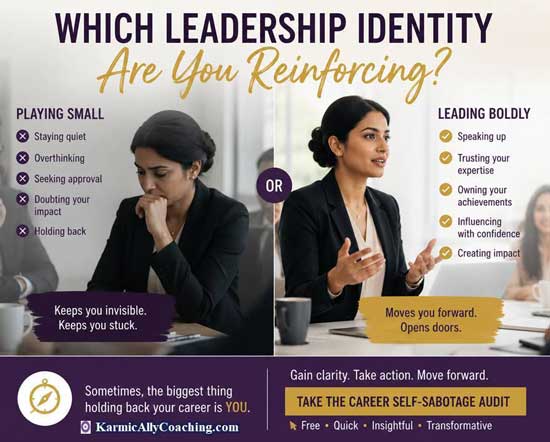
The hidden career cost of getting Leadership Identity wrong
The truth is that most women professionals don’t struggle because they lack talent.
They struggle because they continue operating from an identity that no longer serves their ambitions.
In other words, they
- stay hidden when they need visibility
- downplay when they need ownership
- seek permission when they need influence
- focus on proving competence when they should be demonstrating leadership
The result?
Career stagnation that feels confusing because they’re doing everything they’ve been told should work.
What you need to remember is that leadership isn’t just about what you do.
It’s about who you believe yourself to be.
When your leadership identity shifts, your communication, confidence and visibility changes.
And ultimately, your career trajectory changes.
Are you ready to stop being overlooked?
Many women don’t realize they’re bumping up against a career ceiling created not by a lack of talent, but by outdated beliefs about visibility, leadership, and self-advocacy.
If you’ve recognized yourself in these leadership identity traps, the next step isn’t working harder.
It’s identifying the hidden behaviors, beliefs, and patterns that may be keeping you stuck below your potential.
That’s exactly why I created Breaking the Career Ceiling.
This practical resource helps ambitious women professionals identify what’s really standing between them and their next level of leadership, influence, visibility, and career growth.
Whether you’re aiming for a promotion, a leadership role, or simply greater recognition for the value you bring, you’ll gain insights to help you move forward with clarity and confidence.
👉 Get Breaking the Career Ceiling here
Because sometimes the biggest obstacle to career growth isn’t a lack of capability. It’s the invisible ceiling you’ve been taught to accept.


 Posts
Posts
 I adhere to the Certified Coaches Alliance Code of Ethics and Standards. A copy is available on request.
 Let's Talk through the Connect Form: