
This post has already been read 89 times!

Leadership identity isn’t revealed when everything is going well.
It’s revealed when plans fall apart, emotions run high, and circumstances test your ability to stay grounded.
Your leadership identity isn’t just pertinent to the corporate workplace. It’s also revealed with how you manage your outside office world.
That week, while caring for a sick Coco Junior and dealing with unexpected disruptions at home (including the freezer thermostat malfunction from heat wave), I found myself reflecting on something I often discuss with clients.
How we manage our energy shapes how we lead.
It reminded me how quickly unexpected events can drain our energy and pull our attention away from what matters most.
As part of my own energy management, I stayed away from social media and avoided the news cycle. I reduced interactions with difficult people protecting my boundaries wherever possible.
Instead, I focused on protecting my energy, used tan t’ien stored energy. I stayed connected to what I wanted to accomplish during the week.
But as I reflected on it, I realized this wasn’t just an energy management strategy.
It was a leadership identity choice.
Because, as I mentioned earlier, leadership isn’t only about how you show up when everything is going well.
It’s about who you choose to be when circumstances are less than ideal.
When deadlines are looming and your priorities collide.
You are surrounded by people who are stressed, reactive, or overwhelmed.
Your leadership identity is revealed in those moments.
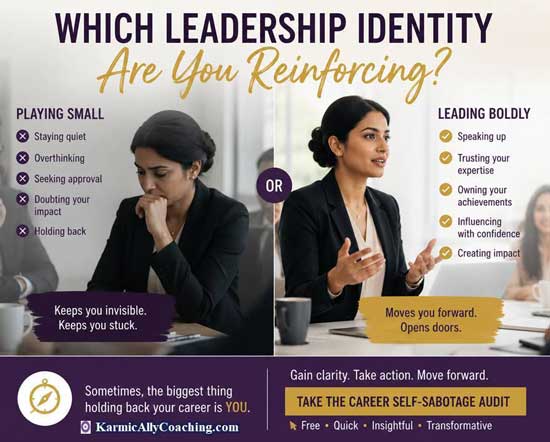
Do you become consumed by the chaos?
Or do you become the calm presence others can rely on?
The truth is that while we cannot control every circumstance, we can control how we respond to it.
Reflection Questions
Ask yourself:
- What situations drain my energy most quickly?
- What helps me recover?
- Who do I become under pressure?
- What leadership identity am I reinforcing through my current habits?
Energy Management is a Leadership Skill
Many professionals think leadership development means improving communication, strategic thinking, or visibility.
But leadership identity is also shaped by how you manage your personal energy.
Your energy affects:
- How you respond under pressure
- How others experience your presence
- Your decision-making quality
- Your influence and executive presence
You don’t just lead with your words.
You lead with your state. Your energy management is superior to you time management skill if you really want to maintain productivity.
Here are five leadership identity practices that help me stay grounded when life feels chaotic.
Regulate yourself first
Before you can lead others, you must lead yourself. It’s what we call the Leader of One.
When your stress levels rise, your ability to think clearly, communicate effectively, and make sound decisions decreases.
One of my favourite techniques is gently tapping my heart with the fingers of my left hand, breathing deeply, and affirming:
“All is well.”
The specific technique matters less than developing the habit of returning yourself to a calm and resourceful state.
Focus on what is within your control
Strong leaders don’t waste energy fighting reality.
They identify what they can influence and direct their attention there.
When something falls outside your control, acknowledge it, release it, and refocus on where you can make an impact.
Done properly, we can influence others without becoming a control freak in a crisis.
Build your resilience muscle
Resilience is not something you either have or don’t have.
It’s a capability that grows through practice.
A resilient leader:
- Leans into their strengths.
- Seeks support when needed.
- Focuses on solutions rather than blame.
- Maintains perspective.
- Chooses optimism without ignoring reality.
Ask: “What is this situation teaching me?”
Every challenge contains information.
Sometimes the lesson is about priorities.
Sometimes it’s about boundaries.
It can also be about discovering capabilities you didn’t know you had.
Leaders who grow consistently are those who remain curious, even during difficult moments.
Practice Perspective
Leaders who sustain themselves over time learn to notice both challenges and resources.
Gratitude creates perspective and that perspective creates better decisions.
Gratitude doesn’t ignore problems. It prevents problems from becoming your entire focus.
When you acknowledge what is working, you create the emotional balance needed to navigate what isn’t.
And that is often what separates reactive leadership from intentional leadership.
The leaders who stand out aren’t necessarily those with the fewest challenges.
They’re the ones who consistently choose who they will be in the face of those challenges.
That’s leadership identity in action.
Here’s my question for you:
When things become stressful or chaotic, who do you choose to be?
Final Thoughts
Leadership identity isn’t built in grand moments.
It’s built in everyday choices:
- How you protect your energy
- Your response to setbacks
- How you recover and
- How you show up when conditions aren’t ideal.
Because the question isn’t whether challenges will come.
The real question is:
Who will you choose to be when they do?
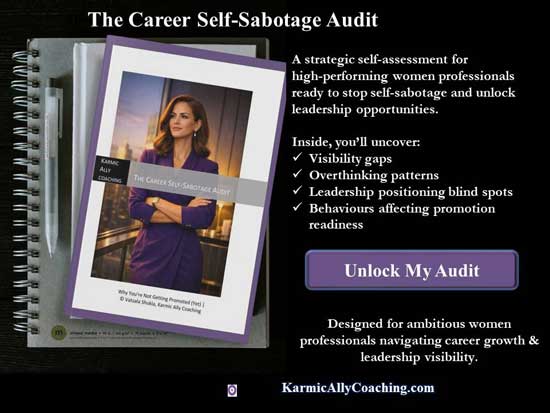
Curious whether hidden habits may be affecting your confidence, visibility, and leadership presence? Download my free Career Self-Sabotage Audit.

 Posts
Posts
 I adhere to the Certified Coaches Alliance Code of Ethics and Standards. A copy is available on request.
 Let's Talk through the Connect Form: