

This post has already been read 88 times!
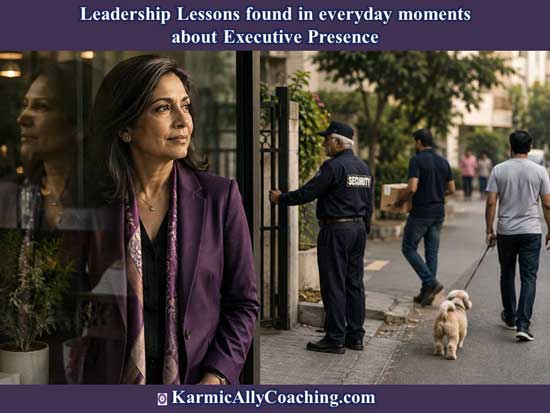
We tend to think of leadership lessons as something we learn in conference rooms, from difficult bosses or from leadership programmes.
We lean forward to learn leadership lessons from boardroom conversations, performance reviews and high-stakes business decisions.
But some of the most valuable leadership lessons I’ve learned didn’t happen at work at all.
They happened during an attempted scam.
While walking Coco Junior.
And, years ago, while listening to an angry man shouting on the telephone from my father’s office in Minsk.
None of these moments looked like leadership lessons at the time.
Yet each one taught me something about how we think, how we treat people, and how others experience us.
And perhaps that is the real lesson:
Leadership isn’t confined to the corporate world.
It shows up in the small, ordinary moments when nobody is watching for your “leadership behavior.”
Sometimes, leadership means refusing to be rushed

Recently, I experienced my first attempted “digital arrest” scam.
My phone rang from a number that hadn’t been flagged as spam.
A recorded voice informed me that my number had been linked to criminal activity and that I should stay on the line to be connected to an official in Mumbai.
Then came the waiting music.
Oddly enough, that was what saved me.
I was working against a deadline and simply didn’t have the patience to wait.
So I disconnected the call and went back to what mattered.
My immediate thought was:
“If this is genuinely important, they’ll call again.”
Only afterwards did I realise that I’d narrowly avoided what has become a common cyber scam.
Looking back, the waiting probably wasn’t accidental.
It was part of the psychological strategy.
When someone tells us we’ve done something wrong, our nervous system can react before our rational mind does.
Fear narrows our thinking.
Anxiety makes us more compliant.
Urgency makes us want to solve the problem immediately.
And once panic takes over, we stop asking logical questions and start looking for the fastest way out.
Later that morning, while collecting a courier package, I mentioned the incident to our Society Supervisor.
He smiled and told me these calls had become surprisingly common.
He had once received a call claiming that his son’s office had been raided and that money had to be transferred immediately to secure his release.
His son works from home, so he ignored the call.
Sadly, he also told me that an elderly resident in his housing complex hadn’t been so fortunate and had lost a significant amount of money.
That conversation stayed with me.
Because we often think executive presence is about how confidently we speak in a meeting.
But what if it is also about what happens inside us when someone deliberately triggers fear, pressure or confusion?
Can we pause?
Do we question?
Can we resist the urge to react?
Can we give ourselves enough space to think?
That is leadership too.
It is also social awareness.
Before we can respond intelligently to what is happening around us, we have to notice what is happening within us.
In an increasingly complex world, emotional regulation and critical thinking are becoming just as important as technical expertise.
Sometimes, the most powerful leadership decision you can make is simply:
Don’t let someone else dictate the speed of your response.
The uniform doesn’t define the person
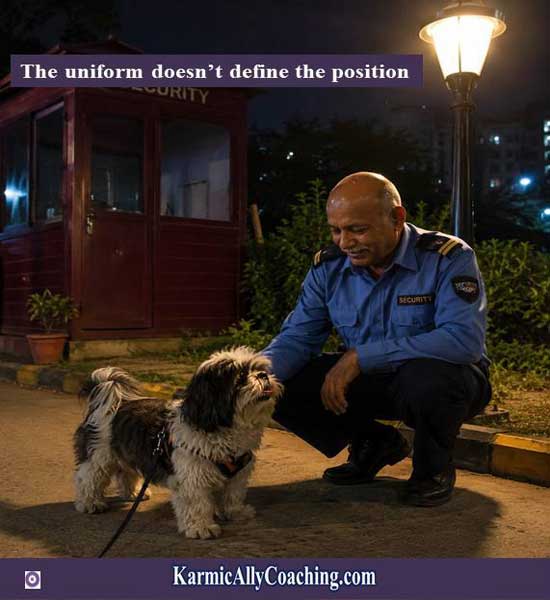
Another leadership lesson came from somewhere far more ordinary: walking Coco Junior through our housing society.
Our society had recently hired an elderly security guard on a temporary basis.
One evening, I stopped to chat with him.
He was cheerful, knowledgeable and genuinely interested in helping residents.
Our conversation turned to mosquitoes and stagnant water.
He explained how water collecting underneath potted plants could become a breeding ground and mentioned that he had tried to warn one resident.
The response?
“Your badge says Security Guard. Just focus on security and stop telling me about mosquitoes.”
His advice was dismissed because of the uniform he was wearing.
Then he told me something that completely changed the story.
Before retiring, he had worked as an Inspector with the Municipal Corporation, responsible for inspecting premises for mosquito breeding and enforcing public health regulations.
In his previous role, he would have had the authority to fine that very resident.
The only thing that had changed was his uniform.
His knowledge hadn’t.
His experience hadn’t.
And his dignity certainly hadn’t.
It made me think about how easily we confuse status with expertise.
We listen to job titles.
We look at designations.
And we notice who has the corner office, the expensive suit or the impressive LinkedIn profile.
Sometimes, without realizing it, we decide whose opinion deserves our attention before we’ve even heard what they have to say.
That is a social awareness blind spot.
We aren’t necessarily seeing the person in front of us.
We’re seeing the label we’ve attached to them.
Good leaders do the opposite.
They stay curious.
They recognize that wisdom can come from unexpected places.
A receptionist may notice something the CEO has missed.
The driver may understand a customer’s frustrations better than the sales team.
The newest employee may ask the question everyone else is too afraid to ask.
An office assistant may know exactly where a process is breaking down.
And yes, the security guard may know more about mosquito breeding than the person living behind the gate.
Leadership isn’t about deciding who deserves respect. It’s about giving respect first.
When people feel respected, they are more likely to contribute.
When they feel dismissed or invisible, everyone loses.
These days, whenever I’m walking Coco Junior or driving through the gate, that same security guard greets me with the biggest smile and a cheerful wave.
It costs nothing to treat someone with dignity.
Yet for the person receiving it, it can mean everything.
And perhaps that is one of the simplest tests of character:
How do you treat people who cannot advance your career?
We all have a “Sometimes”
And then there is Sometimes Sergei.
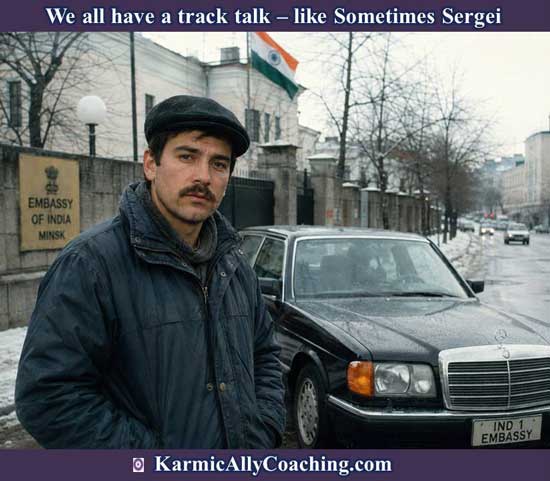
Years ago, I had arrived in Minsk from Warsaw, having wound up my life there to come home and recuperate and to help my family relocate to Tunis for my father’s next Ambassadorial posting.
One day, while I was playing with our four dachshunds, I could hear someone shouting from the living room.
“You are all peegs. I will keel you!”
I was stunned.
Nobody shouted at Dad on the phone.
And nobody called him a pig.
Naturally, I asked who it was.
“Oh, it’s Sometimes Sergei,” Dad said. “He’s upset about losing his job.”
Sergei had been a driver at the Embassy.
He had recently been fired after one of the two Indian Embassy Mercedes was stolen.
From what I gathered, he had taken the new Military Attaché to a market famous for electronic goods.
The car was left unlocked.
The anti-theft device didn’t work.
And the vehicle had also apparently been taken without authorization from the Ambassador or Head of Chancery.
The local police told the Embassy the Mercedes was as good as gone.
This was in the years following the dissolution of the Soviet Union, when stolen Mercedes parts were apparently quite a business.
There was even a running joke among the diplomats about driving down a particular road and buying back their stolen hubcaps for a few dollars.
But a whole Mercedes?
That was a different ballgame.
And now Sergei had lost his job.
Hence the phone call.
But why “Sometimes Sergei”?
Because Sergei had a peculiar habit.
Whatever question you asked him, his answer invariably began with:
“Sometimes…”
Sometimes.
It became his trademark.
His track talk.
And that got me thinking.
We all have a track talk.
Words, phrases and themes we return to so often that people begin to associate them with us.
Some leaders constantly say:
“I’m exhausted.”
“I’m overwhelmed.”
“Everyone here is useless.”
“It’s such a difficult environment.”
“That will never work.”
“What were they thinking?”
“It’s impossible to get anything done around here.”
They may not realize how often they say these things.
But other people notice.
And over time, those words become part of the person’s professional identity.
The leader who
- Constantly talks about problems can become associated with problems.
- Routinely dismisses ideas can become known as negative or resistant.
- Repeatedly talks about being overwhelmed may unintentionally create the impression that they struggle under pressure.
None of this necessarily reflects their actual capability.
But perception is built through repetition.
And that is where executive presence becomes much more interesting than simply “looking executive.”
Your executive presence isn’t only about how you dress, speak in meetings or carry yourself in a room.
It is also shaped by the story people repeatedly hear from you.
Your words, reactions, assumptions and your habitual complaints.
Your responses under pressure, your treatment of people and your ability or inability to pause before reacting.
All of these become part of your leadership brand.
Your track talk becomes part of how people experience you.
The leadership skill hiding underneath all three stories
Put these three stories together and a pattern emerges.
The scam taught me to notice what was happening within me before reacting to what was happening around me.
The security guard taught me to notice the assumptions I make about other people and to question whether I’m really seeing their expertise.
Sometimes Sergei taught me to notice the patterns in my own communication and how repetition shapes other people’s perception of me.
3 Different situations and 3 different lessons.
But underneath all three was the same skill: Social awareness.
The ability to notice what is happening -within ourselves, between people and around us -before we decide how to respond.
And perhaps that is one of the most overlooked foundations of executive presence.
You cannot respond intelligently to what you haven’t noticed.
You cannot influence a room you haven’t learned to read.
And you cannot deliberately shape your leadership reputation if you aren’t aware of the signals you’re sending.
Leadership begins with noticing
This is why I’ve become increasingly interested in the everyday moments that teach us about leadership.
We don’t need to be sitting in a boardroom to practice leadership.
Your leadership is being practiced every day.
- How you respond when someone annoys you
- In how you treat the person serving you
- In whether you listen to someone whose job title is below yours
- How you behave when you’re stressed
- In the stories you repeatedly tell about your colleagues
- The words you use when something goes wrong
- In whether you allow fear to make decisions for you
- In whether you make people feel seen or invisible
These moments may seem insignificant, but they aren’t.
They are rehearsals.
And over time, those rehearsals become habits.
Those habits become behaviors.
Those behaviors shape how people experience you.
And how people experience you ultimately influences your leadership reputation.
Try this for a week
Pay attention to your everyday moments.
Notice:
- What triggers you?
- What do you complain about repeatedly?
- Whose opinions do you automatically respect and whose do you dismiss?
- How do you behave when you’re stressed?
- What phrases do you use so often that your colleagues could probably finish the sentence for you?
- Do people feel more confident after interacting with you or smaller?
- What might you be missing because you are looking at a person’s role rather than the person?
You don’t need a leadership assessment to begin answering these questions.
You simply need to observe yourself.
Because leadership awareness begins with noticing.
And perhaps the next time you find yourself in an ordinary, frustrating, funny or unexpected moment, pause before you dismiss it as “just life.”
It may be offering you a leadership lesson.
Want to become more intentional about what you’re noticing?
The more I observe these everyday interactions, the more convinced I am that social awareness is one of the most underrated leadership skills.
We are constantly reading people, interpreting situations and making decisions based on what we notice—or fail to notice.
The challenge is that most of us were never taught how to do this deliberately.
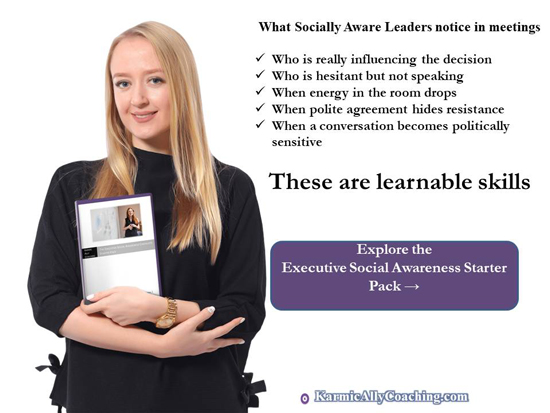
That’s why I created The Executive Social Awareness Starter Pack.
It includes practical checklists to help you become more intentional about reading the room, recognising subtle workplace dynamics, interpreting social cues, understanding the emotional climate and becoming more aware of the signals you are sending.
Because executive presence isn’t just about how you show up.
It’s about how accurately you see what’s happening around you.
Explore The Executive Social Awareness Starter Pack →
Leadership isn’t something you practice only at work.
You practice it everywhere.
And it begins with noticing.
And unlike Sometimes Sergei, you get to choose your track.

 Posts
Posts
 I adhere to the Certified Coaches Alliance Code of Ethics and Standards. A copy is available on request.
 Let's Talk through the Connect Form: