

This post has already been read 3 times!

There’s a moment many professionals quietly arrive at, but almost no one knows how to put a name to it.
You’re not failing.
You’re not lazy.
You aren’t even “burnt out” in the way people casually describe it.
And yet, something feels off.
This is how you experience it.
Work that once stimulated you now feels mechanical. Progress feels slower even when you’re doing more. The ambition is still there, but it’s heavier, foggier and less obedient.
This is what most people call a mid-career rut.
But that label is dangerously shallow.
That’s because beneath that surface frustration lies something far more precise and powerful.
It’s a biological shift and a psychological reorganization.
An identity fracture trying to become an upgrade.
And here’s the part most people miss.
After you’ve been working for 20 years or more, it’s natural to assume that you know how to manage your career.
But research tells a different story.
A widely cited study in the Harvard Business Review found that mid-career professionals, especially those between 40 and 48, are the most likely to make decisions that quietly undermine their long-term success.
They put off decisions when they should be examining what needs to change.
Not because they lack intelligence or experience, but because they’re navigating invisible pressures: daily demands, fear of making the wrong move, and the tension between innovation and perceived risk.
I’ve shared the story of how a brave resilient lady discovered during a consultation that she needed to figure out what direction she wanted to take but needed to first figure out what was making her unhappy.
It’s a classic example of how this mid-career rut manifests itself.
In other words, the very stage where you should feel most in control is often where your internal systems are most conflicted.
What follows are five rare, scientifically grounded truths about the mid-career rut.
These truths don’t just explain what’s happening but fundamentally change how you respond to it.
Reflect on each truth and ask yourself – do I relate to it?
1. Your brain has outgrown your current Rewards System
The work didn’t become meaningless. Your brain stopped finding it meaningful.
Neuroscience Layer:
In earlier career phases, your brain is wired for visible wins like titles, promotions and recognition. These activate dopamine pathways that reinforce effort.
But over time, the brain adapts. The same wins stop producing the same internal reward.
So, your motivation fades. Not because the work is empty, but because your brain is asking for something deeper.
Psychological Layer:
This is where boredom creeps in. Not because you’ve lost ambition but because your ambition has matured.
Philosophical Shift:
You are no longer driven by proving yourself.
You are driven by expressing yourself.
When that happens, you require an entirely different game plan.
2. You’re experiencing Identity Lag, not Lack of Clarity
Your external life is running on an outdated version of who you are internally.
Neuroscience Layer:
Your brain continuously updates your identity based on experience. But your habits, environment, and role often lag behind that update.
This creates friction.
Psychological Layer:
You feel stuck. But the deeper truth is sharper:
You’ve already outgrown your current identity, but your life hasn’t caught up.
This is exactly where many mid-career professionals freeze.
The fear of making a wrong move, of losing credibility, or stepping into uncertainty keeps them looping in roles that no longer fit.
Philosophical Shift:
Clarity is not your problem. Permission is.
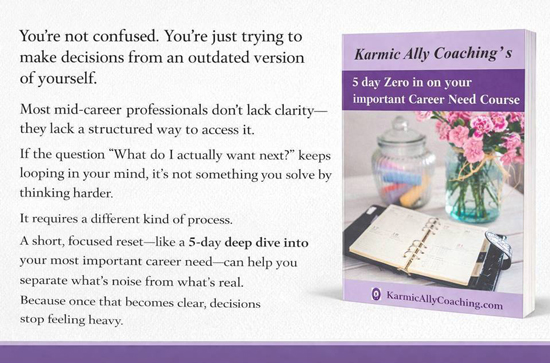

A focused 5-day reset to cut through the noise and get clear on your next career move.
3. Your cognitive load is quietly destroying your sense of progress
You’re not stuck. You’re overloaded in a way that blocks forward momentum.
Neuroscience Layer:
As responsibility increases, your brain’s decision-making system becomes saturated with too many inputs and too many demands.
When that happens, the brain defaults to efficiency and not innovation.
Psychological Layer:
You feel busy but stagnant. Productive but unfulfilled.
And because you’re still performing, no one questions it.
This includes you.
Philosophical Shift:
Just because you can carry it doesn’t mean you’re meant to.
4. Your nervous system is rejecting performance without purpose
You can still perform, but your body no longer wants to sustain it without meaning.
Biological Layer:
Years of operating under pressure condition your system to deliver under stress. But over time, without purpose-driven engagement, the body starts resisting.
Fatigue becomes constant. Motivation becomes forced.
Psychological Layer:
This is where people quietly disengage even while still showing up.
Philosophical Shift:
Your capacity hasn’t diminished.
Your tolerance for misalignment has.
5. You’re wired for expansion but trapped in optimization
You’ve been trained to improve systems, not reinvent them and now that’s the problem.
Neuroscience Layer:
Your brain shifts into optimization mode as you gain expertise. But fulfilment requires exploration – novelty, challenge and expansion.
Without it, the brain signals stagnation.
Psychological Layer:
You’ve mastered your role. And that’s exactly why it feels limiting.
Philosophical Shift:
The next version of your career will not come from doing more.
It will come from becoming more.
What this means in Real Life
The research is clear: mid-career professionals are at risk of becoming undervalued and overworked.
Not because they lack capability, but because they’re navigating fear, pressure, and internal misalignment.
And when that happens, most people try to solve the problem at the surface level.
They work harder while waiting for clarity.
They distract themselves with short-term fixes.
But if you’re feeling the early signs of a mid-career rut, the real work is different.
It’s deeper, more precise and far more transformative.
How to recalibrate without burning everything down
If this is a transition and not a failure, then your next move is not drastic.
It’s intentional.
Dealing with Fear and Boredom
- Shift from execution to strategy. Start thinking beyond tasks and towards influence and impact.
- Ask for real feedback. Not validation, but perspective.
- Rebuild your network. One meaningful conversation a week can open unexpected doors.
- Find a mentor who reflects where you’re going and not where you’ve been.
- Keep learning but apply it in real time.
- Review your career direction every six months. If nothing changes, that’s a decision. Update your resume and social media profiles. Set specific goals to strive for.
Creating Work-Life Balance that actually supports Growth
- Treat self-care as a non-negotiable performance tool.
- Strengthen relationships that ground your identity beyond work.
- Use your time outside work to expand and not just recover.
- Reconnect with purpose through reflection, spirituality, or values.
- Work in alignment with your energy, not just your schedule.
- Lighten the emotional weight you attach to everything.
Where most people get stuck (and why it matters)
At this stage, the biggest trap is not lack of effort.
It’s lack of direction.
Because once your internal system has shifted, generic advice stops working.
What you need instead is precision.
You need to identify:
- What actually matters now
- What no longer fits
- And what your next move needs to optimize for
Most importantly you need a structured way to arrive at those answers without overthinking, second-guessing, or stalling for months.
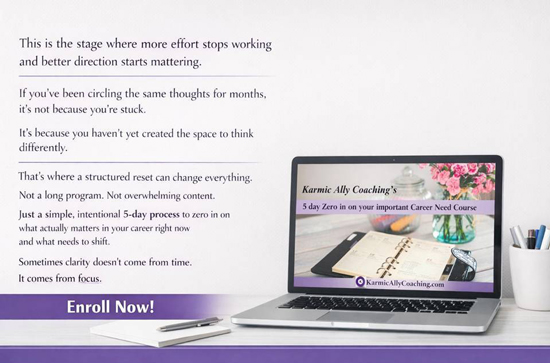

No overwhelm. Just clarity on what needs to change and what doesn’t.
A smarter way to find your next move
This is exactly where a focused, time-bound process becomes powerful.
Not another long course or endless introspection or vague journaling prompts.
You need a contained space where you can zero in on what truly matters in your career right now.
A short, structured intervention, when done properly, can cut through months of mental noise.
That’s the idea behind a 5-day approach to identifying your most important career need.
Five days to:
- Step out of autopilot.
- Separate signal from noise.
- Make decisions from clarity and not pressure.
Because the truth is, you don’t need more information.
You need sharper insight.
The opportunity hidden in the Rut
Your mid-career phase is not meant to be predictable.
It’s meant to be powerful.
This is where you stop chasing external validation and start building internal alignment.
This is where your work becomes less about proving and more about positioning.
And this is where small, intentional shifts create disproportionate impact.
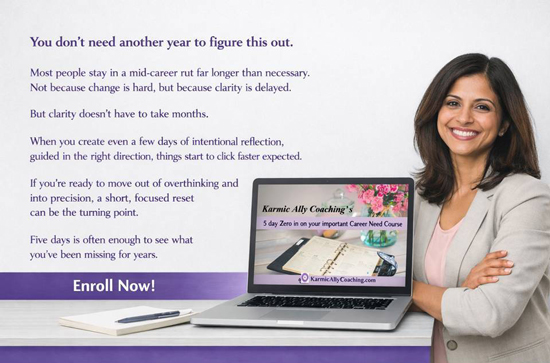

Because clarity shouldn’t take another year.
The Bottom Line
A mid-career rut is not a sign that something is wrong with you.
It’s a signal that something inside you is ready to evolve.
Ignore it, and you stay busy but disconnected.
Respond to it, and you unlock clarity, direction, and a level of professional alignment most people never reach.
The next version of your career is not hidden.
It’s waiting for you to get precise about what actually matters now.
And once you do, everything starts to move.
If this hit deeper than expected…
There comes a point where insight isn’t enough.
You don’t need more information.
You need a way to translate what you’re feeling into clear direction.
That’s exactly what a focused 5-day process is designed to do.
Not to overwhelm you.
Not to push you into drastic decisions.
But to help you zero in on what actually matters in your career right now and what your next move needs to be built around.
👉 Start your 5-Day “Zero In on Your Important Career Need” reset here

 Posts
Posts
 I adhere to the Certified Coaches Alliance Code of Ethics and Standards. A copy is available on request.
 Let's Talk through the Connect Form: