

This post has already been read 1 times!
Many professionals believe that if they demonstrate gravitas then they will be perceived as having executive presence.
They are willing to invest in training to acquire and polish this Wow factor.
But here’s the truth. Gravitas becomes visible and perceived by others when expressed through your communication style.
This means speaking confidently, presenting clearly, or using the right language in meetings.
Those skills certainly matter.
But experienced leaders know that effective communication begins even before you say a word.
Professionals with strong executive presence often notice signals that others miss.
They pay attention not just to what is being said, but to what is happening around the conversation.
In my previous post, I pointed out that when you learn to read your boss’s mood, you will also be able to read other people.
That’s because you’ll be developing your social awareness skill.
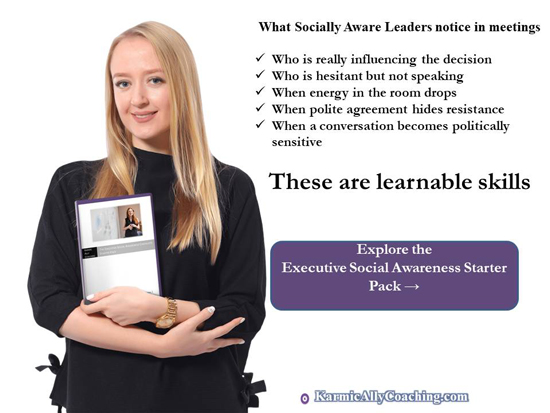
Social awareness is one of the most important building blocks of executive presence because it allows professionals to adjust their communication based on the dynamics around them.
If you’re exploring ways to strengthen your leadership presence more broadly, you may also find my Executive Presence Checklist helpful.
Executive Presence is not just how you speak. It’s how well you read the room
It begins with understanding the emotional and relational dynamics in the room.
So, you consider the following questions:
What is the emotional tone in the room?
Who feels invested in the topic?
Can someone feel threatened by the idea?
Who holds informal influence in the discussion?
Who seems engaged or hesitant?
Is there tension or resistance present?
Do I need empathy, clarity, or authority here?
This is called doing an emotional climate scan. It’s part of Part of the Executive Social Awareness Starter Pack. [Get the Checklists]
It’s important to know how to read the room because sometimes the emotional tone of a conversation changes. Quite possibly, someone in the room is experiencing pressure or frustration.
In some cases, leaders may react unpredictably under stress, which is why learning how to stay composed in these situations is also important.
I wrote more about this in my article on how to keep calm and composed when your boss is volatile.
Professionals with strong social awareness notice these signals quickly and adjust their approach accordingly.
That ability is a major reason their ideas gain traction.
Decisions in organizations are rarely purely logical
Most workplaces operate on an unspoken assumption that decisions are made primarily through data and logic.
In reality, decisions are influenced by a mix of:
- relationships
- perceived risk
- organizational politics
- emotional reactions to change
A client once told me that her project proposal was technically sound but consistently stalled in meetings.
When we looked closely at the dynamics, she realized a senior colleague felt the proposal would reduce their team’s influence.
Once she addressed that concern directly, the conversation shifted and the proposal moved forward.
So, a proposal may be technically sound but still encounter resistance if it disrupts someone’s priorities or authority.
Socially aware professionals recognize these dynamics early and shape their communication to address both the logical and human aspects of the conversation.
Social Awareness aids Leaders to detect resistance early
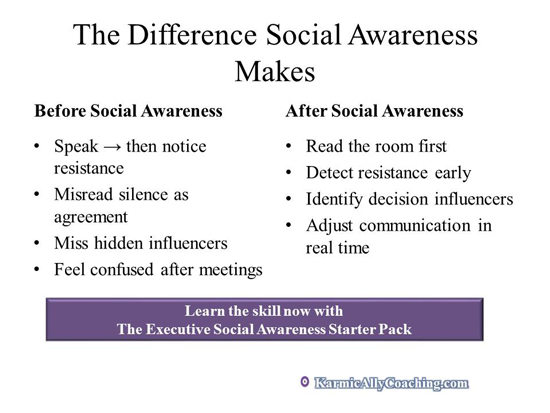
One of the most valuable leadership abilities is detecting unspoken resistance before it becomes open opposition.
I remember my first boss and mentor who demonstrated this skill to perfection.
During our audit planning meetings, he’d observe each one of us and would suddenly ask one of us what we thought of the strategy on a particular audit section.
The team member who was asked would fidget a bit and then come out with their risk related concerns. Not an easy thing to do in front of the boss. However, this would lead to better dialogue and quite often gave us all a different perspective.
Resistance rarely appears immediately.
It often shows up through subtle signals such as:
- polite but vague responses
- sudden silence after an idea is presented
- reduced eye contact or engagement
- side conversations after meetings
Professionals who notice these cues early can address concerns proactively instead of being surprised later when progress stalls.
Social awareness is equally valuable outside formal meetings.
For example, networking conversations often involve interpreting subtle cues about interest, openness, or shared priorities.
I explore this further in my article on small talk with people who feel like they come from a parallel universe at networking events.
The skill that strengthens Influence without increasing Authority
Influence is a powerful tool to be used with care.
Many professionals believe influence comes primarily from formal and legitimate authority and power bases.
In my post on the 5 Leadership Bases, I share how we can exercise power like a leader in the workplace even when we don’t have the title of a boss.
In fact, some of the most effective leaders influence outcomes even when they are not the most senior person in the room.
They do this by:
- recognizing the concerns others may hesitate to express
- acknowledging emotional reactions to change
- adapting their message to the priorities of different stakeholders
Social awareness allows them to engage people in ways that build alignment rather than resistance.
Social Awareness is a key signal of leadership maturity
When you are vying for a promotion or a leadership position, developing this skill can be the game changer.
Senior leaders often evaluate potential leadership candidates on more than technical competence.
They look for signs that someone can:
- navigate complex interpersonal dynamics
- recognize the perspectives of multiple stakeholders
- maintain composure in difficult conversations
These capabilities signal leadership maturity.
And they are all rooted in strong social awareness.
Professionals who develop this skill tend to demonstrate a level of presence that makes others naturally view them as leadership material.
This is why professionals who develop strong social awareness often find that their communication becomes more effective.
Ideas presented by them gain more traction, and their executive presence grows naturally over time.

 Posts
Posts
 I adhere to the Certified Coaches Alliance Code of Ethics and Standards. A copy is available on request.
 Let's Talk through the Connect Form: