
This post has already been read 127 times!
Continue the Conversation
If this audio resonated with you, you may also enjoy:
📝 Read:
Small Talk with Folks from a Parallel Universe at Networking Events
A reflective take on why networking conversations can feel strangely out of sync, and how to navigate them with composure.
🎯 Learn:
Create a Confident Elevator Pitch
A practical, self-paced course to help you introduce yourself with clarity, confidence, and credibility in professional settings.
Prefer to read? Here’s the transcript
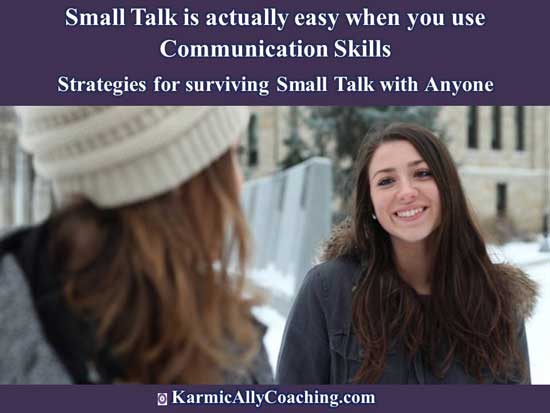
Small talk is often dismissed as superficial, but in professional settings, it quietly shapes first impressions, credibility, and connection.
Whether you’re at a networking event, a conference, or an informal professional gathering, knowing how to navigate these moments with ease can make all the difference.
If small talk ever feels especially awkward or disorienting, like you’re speaking a different language altogether, then you’ll enjoy reading about the lady who walked her cat on a leash and my deeper reflection on that experience.
You’ll find the link to that blog post just below this audio.
Hi, I’m Vatsala Shukla from Karmic Ally Coaching. In this audio, I’m sharing practical strategies to help you move beyond awkward exchanges and into conversations that feel natural, engaging, and purposeful, without forcing connection or performing confidence.
So, let’s begin.
When meeting someone new, small talk is almost unavoidable.
And while it may feel uncomfortable or even pointless at times, it serves an important purpose. It creates a bridge. The key is not to endure it, but to gently take charge of it.
One of the simplest ways to do this is to prepare in advance.
If you know who you’re going to be meeting, take a few minutes to learn something about them beforehand. A small detail—a role, an interest, a recent project—can open the door to a more engaging conversation.
For example, instead of a generic greeting, you might say, “I hear you enjoy playing golf. What’s your favourite course to play?” Questions like these invite people to speak more freely and shift the conversation out of autopilot.
Another overlooked skill is how you introduce people.
When you’re making introductions, say names slowly and clearly. Then add one meaningful detail about each person, something that gives them an immediate starting point for conversation. This small act of thoughtfulness signals presence and leadership, and it instantly elevates interaction.
In fact, in the days when I used to use it when we used to have functions at our house people actually thought that I was highly networked and, the introductions I made lasted for a long time. It improved my reputation to say the least.
A related skill, and one that many people underestimate, is remembering names.
In social situations, most people don’t make much of an effort here. Simply choosing to do so already sets you apart. Use the person’s name early in the conversation, and then once or twice again as you speak. And if you forget, ask. Doing so respectfully leaves a far better impression than avoiding the name altogether.
When you’re answering questions, resist the urge to keep things minimal.
If someone asks you something that could be answered with a yes or no, offer a slightly longer response. Not to dominate the conversation—but to give the other person something to work with.
For example, “Yes, I saw that movie—we watched it while we were on vacation in Goa.” These small additions create openings for natural follow-up.
Equally important is shifting the focus away from yourself.
People generally enjoy talking about their experiences. Thoughtful questions help them feel seen and heard, and they take the pressure off you to perform. Often, the most engaging conversationalists are simply excellent listeners.
And if the conversation begins to stall, don’t panic.
Lulls are normal. When they happen, gently restart the conversation with a prepared comment or question. Most awkward pauses occur when both people run out of safe small-talk territory. A well-placed question can reset the rhythm and move things forward with ease.
Finally, know how to exit gracefully.
If a conversation has run its course, it’s perfectly acceptable to excuse yourself. Simple statements like, “I need to speak with the host,” or “I need to step away for a moment,” work well. Before you leave, thank the person and mention something specific you appreciated about the conversation. This leaves a strong final impression and shows genuine attentiveness.
Small talk isn’t about being clever or charismatic. It’s about presence, preparation, and intention. When you approach it this way, even brief interactions can feel meaningful—and you’ll walk away feeling more confident and composed.
Small talk becomes easier when you know how to introduce yourself clearly and confidently. If first impressions or introductions are something you want to strengthen, I’ve linked my Elevator Pitch course just below this audio. It’s designed to help you communicate who you are and what you do with ease without sounding scripted.
Thank you for listening.

 Posts
Posts
 I adhere to the Certified Coaches Alliance Code of Ethics and Standards. A copy is available on request.
 Let's Talk through the Connect Form: