

This post has already been read 52 times!
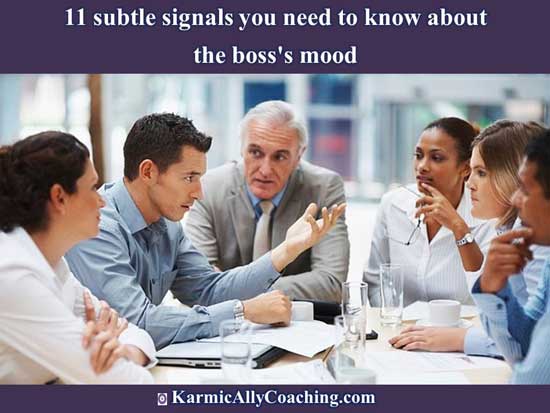
Have you ever walked into a meeting and instantly wondered:
Is my boss in a good mood today… or is this going to be a difficult conversation?
Most professionals quickly learn that a manager’s mood can influence how:
- feedback is delivered
- ideas are received
- decisions are made
The challenge is that few people are taught how to read these signals accurately.
Instead, we guess.
And sometimes we guess wrong.
In my post How to keep calm and composure when your boss is volatile, I shared the experience of my department with a mercurial boss whose behaviour impacted employee morale.
Whether your boss’s behaviour occasionally changes under deadline pressure or one who really needs to manage his emotions, it’s still important to be able to understand your boss.
That is, if you don’t want to jeopardize your mental and professional well-being.
You also need to understand level-headed bosses.
Why reading your boss’s signals matters
While good leaders use positive communication to motivate their teams, all leaders communicate using non-verbal cues. These include subtle signs like:
- tone shifts
- body language
- engagement patterns
- conversational cues
Silence too is a communication cue depending upon the situational context and other non-verbal cues.
It can express disappointment or irritation. In a tense situation, the same silence might be calming, reassuring and give a sense of emotional safety.
Professionals who notice these signals early can adjust their approach and avoid unnecessary friction.
11 signals that reveal your boss’s mood
While one cannot always read the boss accurately, there are ways to assess the boss’s mood. You then know when to approach them and when to stay quiet.
Here are a few examples of signals:
1. Short or clipped responses
This is often indicative of stress or urgency.
2. Rapid interruptions
This may signal impatience or pressure. Your response should be to keep your inputs short and concise and to the point.
3. Avoiding eye contact
Sometimes, this is an indication of distraction or internal focus.
4. Leaning forward and engaging
This body language cue signals openness to discussion.
5. Asking more questions than usual
Can signal curiosity or concern.
6. Checking devices frequently
When this happens, the boss isn’t being rude but may be indicative of competing priorities.
7. Increased formality
Sometimes indicates tension.
8. Sudden silence
More often than not, it means they are evaluating an idea. It’s best for you to stay silent too and not talk to fill the silence.
9. Delegating quickly
This can signal overload.
10. Repeating the same point
This often indicates unresolved concern. Do your best to answer the question being asked or provide more information to remove the concern.
11. Engaging with others but not you
This can make you feel bad and may signal disagreement or distraction. Check on whether you have said or done something to bring out that response.
Why most professionals misread these signals
Sometimes the source of the communication gap could be due to personality clashes, difference in work styles, ineffective feedback or even an expectation gap on both sides.
Some common mistakes that can happen include:
- assuming silence equals agreement
- reacting emotionally instead of observing
- missing hidden workplace dynamics
- focusing only on words instead of behaviour
As an emotionally intelligent professional, becoming aware of the exact problem is the first step.
The simple “Social Awareness Scan”
Here is a small framework you could implement.
Before responding in meetings, quickly observe:
- emotional tone in the room
- engagement signals
- who influences the conversation
- subtle resistance cues
This helps you respond strategically instead of reactively.
It helps you develop your social awareness skill not just when dealing with your boss but also your co-workers.
If you want to get better at detecting workplace signals like these, I created a short report:
7 Signs You’re Misreading the Room at Work
It shows you the subtle cues professionals often miss in meetings and conversations.
Social Awareness is a core Executive Presence skill
As you develop your skill of reading your boss’s mood, you will also be able to read others. That is what will help you develop your social awareness skill.
As a leader or even aspiring leader, you need to develop the ability to:
- interpret signals quickly
- adapt communication style
- manage difficult personalities
- navigate power dynamics
Many professionals use structured tools like a Read the Room Checklist to help them quickly assess meeting dynamics and adjust their communication in real time.
Final Thoughts
Workplace communication is rarely just about words.
Much of what happens in meetings is communicated through signals, tone, and behaviour.
Learning to recognize these cues can dramatically improve how you navigate conversations and influence outcomes.
Start by downloading the report:
7 Signs You’re Misreading the Room at Work

 Posts
Posts
 I adhere to the Certified Coaches Alliance Code of Ethics and Standards. A copy is available on request.
 Let's Talk through the Connect Form: